An asphalt driveway cost calculator can estimate material quantity and test price assumptions. It cannot see the site, diagnose the base, design drainage, or predict a contractor’s mobilization and labor. The best use of the tool is therefore not “get one exact price,” but “build an itemized scope that makes quotes comparable.”
Scope: This article focuses on calculator inputs and quote analysis. For material quotes and dated market indexes, use the asphalt price-per-ton guide. For long-term ownership costs, use the asphalt driveway cost guide.
1. Start with the correct project type
The same square footage can represent very different work:
| Project type | Typical scope questions |
|---|---|
| New driveway | excavation, subgrade, aggregate base, drainage, new asphalt |
| Full replacement | demolition, disposal, failed-base removal, rebuild |
| Overlay | existing pavement condition, milling, leveling, tack, transitions |
| Local repair | failure area, cut depth, base repair, patch material |
An overlay is not a cheaper substitute for reconstruction when the base is unstable. Review widespread fatigue cracking, settlement, and standing water before entering a surface-only price.
2. Calculate material quantity separately
For a rectangular driveway:
Area (ft²) = length × width
Volume (ft³) = area × compacted thickness (in) ÷ 12
Tons = volume × compacted density (lb/ft³) ÷ 2,000
Worked quantity example
For 600 ft² at 3 inches compacted thickness and an assumed density of 145 lb/ft³:
Volume = 600 × 3 ÷ 12 = 150 ft³
Weight = 150 × 145 = 21,750 lb
Estimated quantity = 10.875 US tons
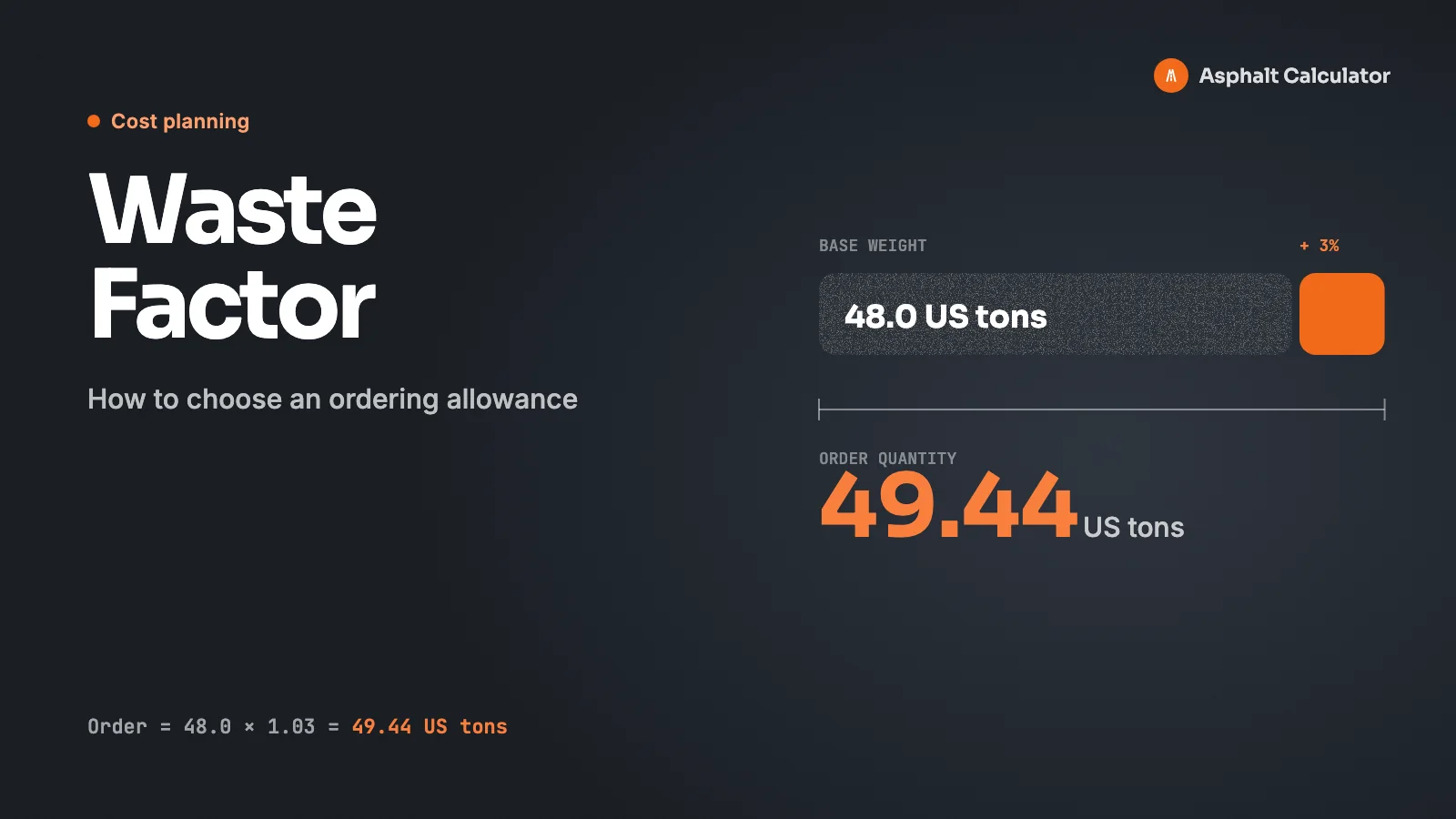
Use the supplier or approved mix-design density when available. Add an allowance only after considering irregular edges, low areas, measurement uncertainty, and the paving plan. Do not add a separate “compaction factor” blindly when compacted thickness and compacted density are already used.
Try the driveway calculator with your dimensions.
3. Build the installed-cost worksheet
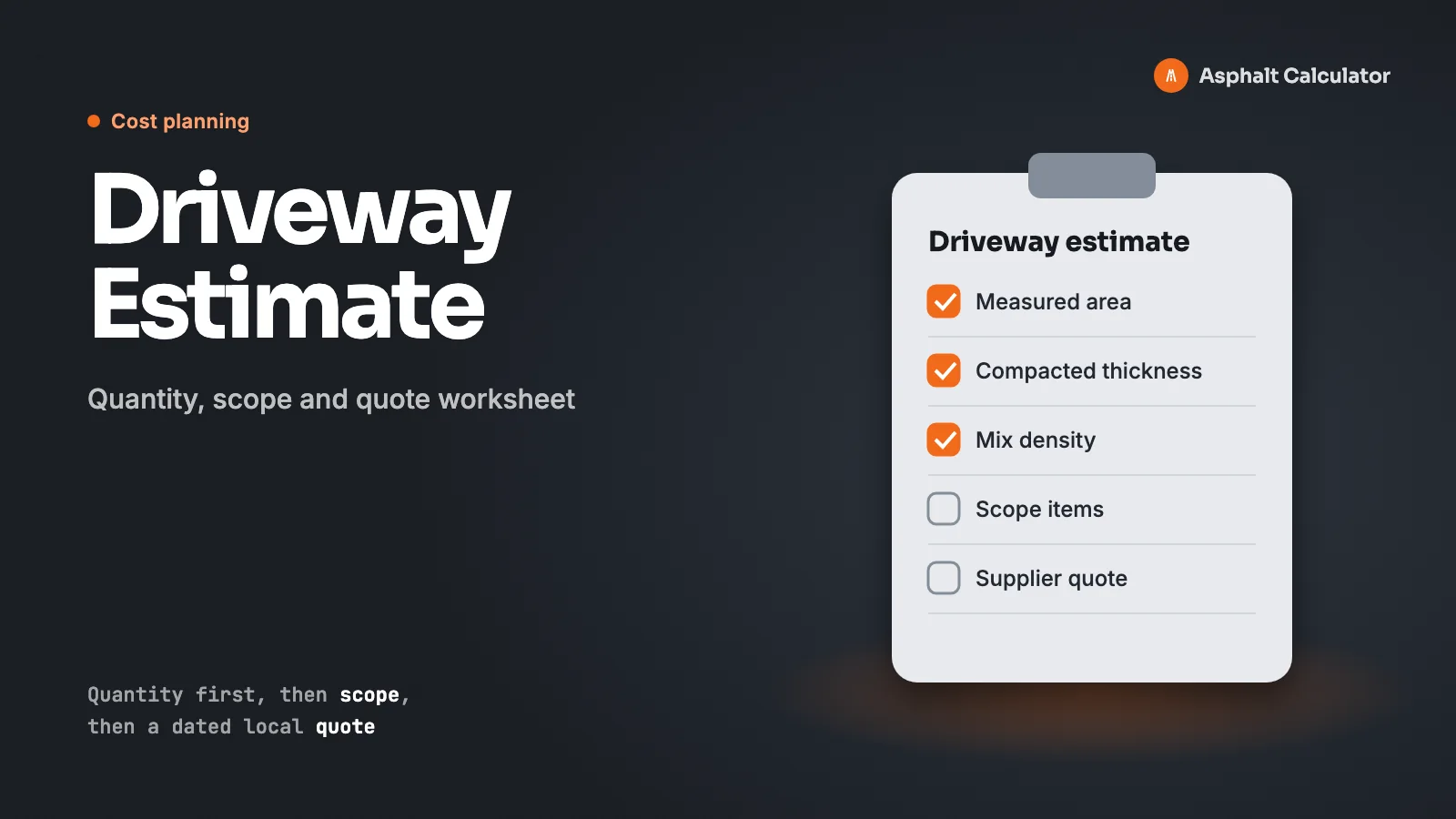
Material tonnage is only one line in a project budget. Fill each row from a dated local quote, and leave unknown prices blank rather than substituting a national average. Do not add a separate charge when it is already included in another row.
| Cost line | Quantity and unit | Local unit price | Extended cost | Inclusions/source/date |
|---|---|---|---|---|
| Removal and disposal | Measured scope | Quote | Quantity × unit price | Record exclusions |
| Base and drainage | Specified scope | Quote | Itemized or lump sum | Keep drainage separate if needed |
| Asphalt material | Estimated US tons or tonnes | Matching price unit | Weight × unit price | State freight inclusion |
| Placement and equipment | Quoted scope | Quote | Quoted total | Check mobilization inclusion |
| Other charges | Permits, testing, tax | Quote | Itemized total | Avoid duplicates |
| Installation total | Sum of included lines | List unpriced work separately |
Check the scope behind each line:
Existing conditions
- Survey or layout
- Demolition and disposal
- Tree roots, unsuitable soil, or buried obstructions
- Utility covers and transitions
- Access limits for trucks and paving equipment
Base and drainage
- Excavation depth
- Aggregate type and compacted thickness
- Geotextile or stabilization, if specified
- Grading, swales, drains, or culvert work
- Proof rolling or other acceptance method
Asphalt work
- Mix designation and supplier
- Compacted lift thickness
- Leveling or wedge quantities
- Tack coat at existing pavement and between lifts where specified
- Paving, rolling, handwork, and edge treatment
Project delivery
- Mobilization and minimum-load charges
- Freight and truck waiting time
- Permits and traffic control
- Testing or inspection
- Overhead, contingency, tax, and profit
This structure explains why multiplying square footage by a national price range often produces a misleading result.
4. Use local prices with dates
State asphalt indexes may track liquid binder adjustments for public contracts. They do not necessarily equal the price of finished HMA delivered to a residential driveway. Likewise, a consumer “cost per square foot” may bundle labor and preparation that your project does not need—or omit work that it does.
For every price input, record:
- What is being priced
- Unit of measure
- Geographic market
- Source and date
- Whether freight, tax, labor, and equipment are included
- Minimum quantity or mobilization conditions
Local written quotes are more relevant than a national average. Use at least two comparable scopes, and preferably three, before treating a range as representative.
5. Compare contractor quotes line by line
Ask each bidder to state:
- Existing pavement removal and disposal scope
- Base material and compacted depth
- Asphalt mix and compacted thickness
- How soft areas and unsuitable soil are priced
- Drainage and final elevations
- Edge, garage, sidewalk, and public-road transitions
- Quantity measurement method and overrun responsibility
- Start window, weather delays, and warranty terms
The lowest total is not comparable if it assumes less base repair, thinner compacted asphalt, or no drainage correction.
6. Treat thickness and material recommendations carefully
Generic residential thickness ranges are screening assumptions, not designs. Passenger vehicles, delivery trucks, RVs, freeze-thaw exposure, soil support, drainage, and local practice all matter. A thicker surface cannot compensate for a saturated or weak foundation.
Similarly, RAP is not a separate low-grade driveway surface by definition. Reclaimed material may be incorporated into a properly designed plant mix, or it may refer to processed millings used as an unbound surface. Those are different products with different performance and pricing.
7. Keep future maintenance separate
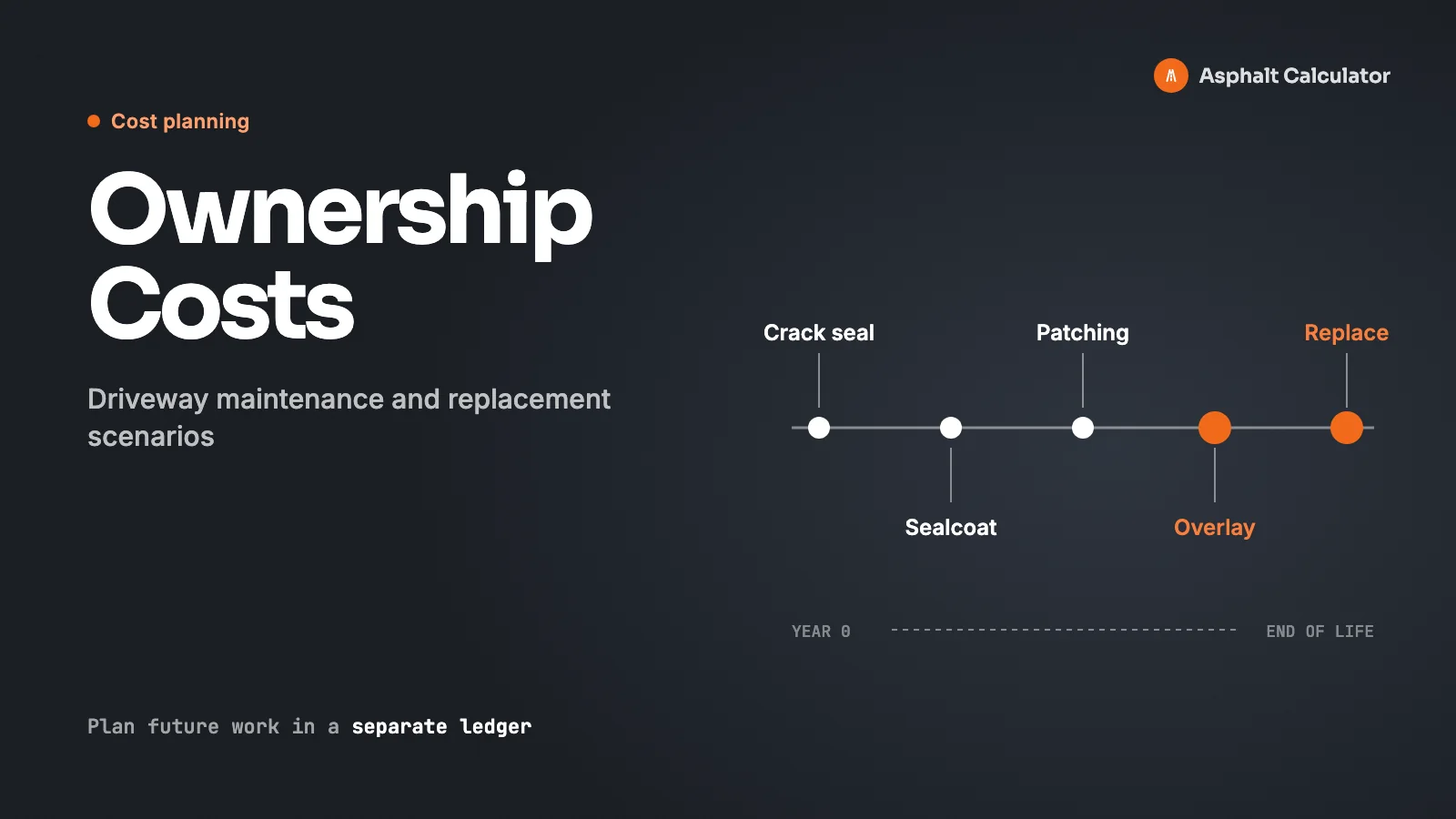
This worksheet covers installation. Keep future repairs and rehabilitation in a separate ownership-cost scenario, with its own timing, price assumptions, and uncertainty. Do not include a hypothetical future overlay in a contractor’s current installation total.
8. Calculator output checklist
Before accepting the result, verify:
- Dimensions and units are correct
- Thickness means compacted asphalt thickness
- Density source is documented
- Irregular areas and low spots are included
- Material cost is not confused with installed cost
- Base, drainage, demolition, and disposal are itemized
- Price source, location, and date are recorded
- Allowance and overrun responsibility are explicit
Sources
- FHWA Asphalt Pavement Resources
- FHWA Life-Cycle Cost Analysis
- New Jersey DOT Asphalt Cement and Fuel Price Indexes
- NAPA Asphalt Pavement Facts
A driveway calculator should make assumptions visible and quotes easier to compare. It should never hide missing site information behind a precise-looking total.