Choosing between an asphalt driveway and a concrete driveway is not as simple as comparing one price per square foot. The better option depends on the complete pavement structure, local material and labor markets, drainage, soil, climate, expected traffic, appearance goals, maintenance access, and how long you expect to own the property.
Short answer: Asphalt often has a lower initial paving cost and can be resurfaced, while concrete may offer a different appearance and maintenance profile. Neither material is automatically cheaper over its full life. Compare local proposals with the same area, removal, base, drainage, thickness, reinforcement, access, and warranty scope.
Asphalt vs concrete driveway comparison
| Decision factor | Asphalt driveway | Concrete driveway | Verify locally |
|---|---|---|---|
| Initial project | Flexible pavement placed and compacted in lifts | Rigid slab placed, finished, jointed, and cured | removal, base, drainage, thickness, access |
| Opening to traffic | Depends on mixture, temperature, compaction, and contractor instructions | Depends on mixture, strength development, curing, and contractor instructions | written reopening time |
| Routine maintenance | Crack treatment and surface preservation may be appropriate | Joint maintenance and crack evaluation may be appropriate | product compatibility and actual condition |
| Major rehabilitation | Milling, patching, or an asphalt overlay may be possible | Partial-depth repair, full slab replacement, grinding, or an overlay system may be possible | failure mechanism and remaining structure |
| Appearance | Usually dark and visually continuous | More color, texture, joint, and finish options | local installer capability |
| Permeable option | Porous asphalt systems exist | Pervious concrete systems exist | soil, reservoir, underdrain, maintenance, permits |
| Cost comparison | Requires an asphalt-specific local quote | Requires a concrete-specific local quote | use life-cycle scope, not one headline unit price |
This table describes broad construction families. A poorly drained or under-designed driveway of either material can fail early, while a well-designed and well-built pavement can perform much better than a generic lifespan estimate suggests.
Is asphalt cheaper than concrete?
Asphalt is often quoted at a lower initial price for residential driveway paving, but that is not a universal rule. Asphalt-plant distance, concrete availability, excavation, disposal, aggregate base, drainage work, small-job minimums, labor capacity, access, permits, and finish details can change the result.
Compare at least these line items:
- measured finished pavement area;
- removal and disposal of the existing surface;
- subgrade correction and aggregate-base thickness;
- asphalt compacted thickness or concrete slab thickness;
- concrete reinforcement, joints, curing, and finish when applicable;
- asphalt lifts, mix designation, density control, and edge details when applicable;
- drainage, grading, trucking, mobilization, permits, and taxes;
- maintenance assumptions, warranty, exclusions, and future repair access.
Use the asphalt driveway cost calculator to estimate asphalt mixture quantity and material-only cost. It does not estimate a concrete alternative or the complete installed project, so enter contractor proposals in a separate side-by-side worksheet.
Which driveway lasts longer?
Do not select a material from a universal lifespan number. Service life depends on structural design, soil support, drainage, materials, construction quality, traffic, climate, utility cuts, maintenance, and the condition threshold used to define “replacement.”
For a defensible comparison, ask each bidder to describe:
- the assumed soil and drainage condition;
- the proposed pavement and base sections;
- how construction quality will be checked;
- expected maintenance and rehabilitation events;
- which failures are covered by the warranty;
- the cost and disruption of future repairs.
FHWA uses life-cycle cost analysis to compare pavement alternatives because initial cost alone does not capture future rehabilitation timing, costs, and user impacts.
Maintenance: sealcoating, joints, and cracks
Asphalt driveway maintenance
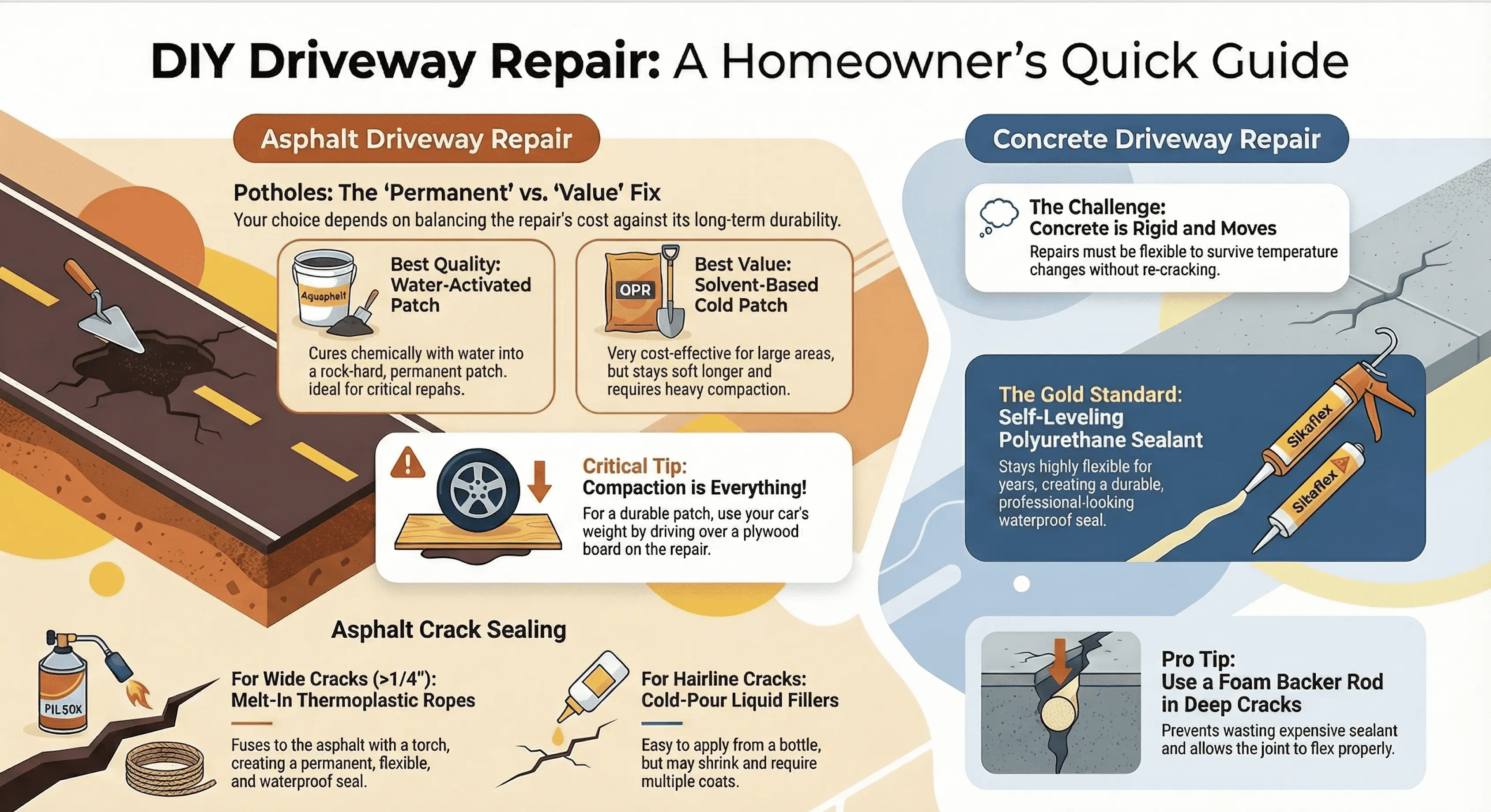
Asphalt maintenance can include cleaning, drainage correction, compatible crack treatment, localized patching, and—when appropriate for the pavement and product—a surface sealcoat. Sealcoating is not a structural repair and should not be applied over unresolved base failure or widespread fatigue cracking.
Estimate a coating only after selecting a product and coverage rate with the asphalt sealcoat calculator. Use the asphalt patch calculator for prepared potholes or localized repairs.
Concrete driveway maintenance
Concrete maintenance can include cleaning, joint inspection, compatible sealant replacement, drainage correction, and evaluation of cracks, settlement, scaling, or spalling. Filling a moving crack does not correct loss of support or slab displacement. Repairs should match the failure mechanism rather than cover the symptom.
Climate and drainage
Freeze-thaw exposure, water, expansive soil, heat, shade, snow removal, deicing chemicals, and tree roots can affect both pavement types. Material choice does not eliminate the need for positive drainage and stable support.
- Water should leave the driveway rather than pond at low spots or enter unsupported edges.
- The pavement section should reflect local soil, frost, traffic, and code requirements.
- Snowplow edges, chains, studs, or heavy equipment can damage either surface under unfavorable conditions.
- Dark asphalt and lighter concrete can have different surface-temperature behavior, but site exposure and material properties matter.
If stormwater infiltration is a project goal, porous asphalt and pervious concrete are complete pavement systems—not simply conventional surfaces with more holes. EPA guidance describes permeable pavement as a surface plus underlying storage and drainage layers that require site-specific design and maintenance.
Repairs and future changes
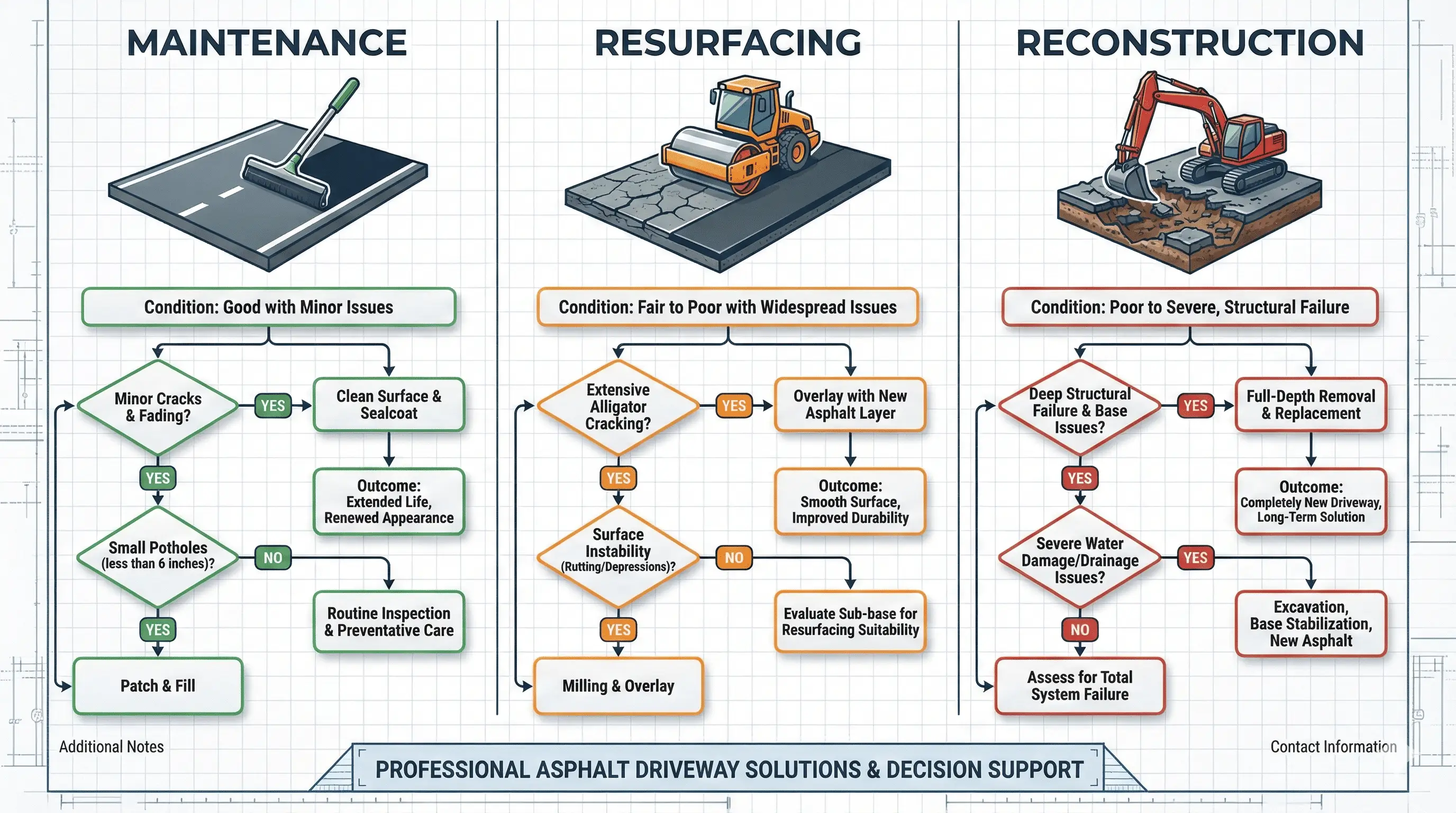
Asphalt can often be milled, patched, or overlaid when the remaining structure is suitable. Concrete repairs may involve joints, partial-depth repair, slab replacement, grinding, or engineered overlays. Utility cuts and additions should be considered before choosing a decorative finish or assuming that future repairs will be visually invisible.
Read the repair, resurfacing, or reconstruction decision guide before comparing rehabilitation options. For an existing asphalt surface that may accept another asphalt layer, see the asphalt-on-asphalt overlay guide.
When asphalt may fit better
Asphalt may be a strong candidate when local paving crews and plants are readily available, initial budget is important, a dark continuous appearance is acceptable, and future milling or resurfacing is practical. The final choice still depends on the proposed section and site conditions.
When concrete may fit better
Concrete may be a strong candidate when the owner values its finish options, jointed slab appearance, local contractor capability, or a project-specific rigid-pavement design. Confirm curing protection, joint layout, reinforcement where specified, surface finish, drainage, and repair expectations.
Quote comparison checklist
Before choosing asphalt or concrete, put both proposals into the same scope:
- same measured area and finished grades;
- same removal, disposal, and access assumptions;
- documented subgrade and drainage corrections;
- material-specific pavement and base section;
- edge, joint, transition, and utility details;
- reopening time and site-access restrictions;
- maintenance and rehabilitation assumptions;
- written exclusions, warranty, payment schedule, and change-order method.
The best driveway is not the material with the strongest generic claim. It is the alternative with a suitable design, clear scope, qualified installation, realistic maintenance plan, and acceptable life-cycle cost for the actual property.