Asphalt density is the weight of mixture occupying a unit of volume. It is the link between a project’s compacted volume and its estimated tonnage:
Weight = compacted volume × compacted density
There is no single density that accurately represents every asphalt mixture. Aggregate type, gradation, binder content, air voids, temperature, sampling method, and achieved compaction can change the result. Use a calculator’s default only for preliminary planning, then replace it with supplier, mix-design, agency, or project quality-control data before ordering.
Density units and conversions
US estimates commonly use pounds per cubic foot (lb/ft³). Metric estimates commonly use kilograms per cubic meter (kg/m³) or megagrams per cubic meter (Mg/m³).
| Conversion | Formula |
|---|---|
| lb/ft³ to kg/m³ | multiply by 16.0185 |
| kg/m³ to lb/ft³ | divide by 16.0185 |
| kg/m³ to Mg/m³ | divide by 1,000 |
For example, 145 lb/ft³ is approximately 2,323 kg/m³. That example is a unit conversion, not a recommended density for every job.
Why compacted density varies
The FHWA Enhanced Durability through Increased In-place Pavement Density report explains that compaction reduces air voids and increases unit weight. It also notes that mixtures using different aggregates can have significantly different densities.
Two projects with the same area and thickness can therefore require different weights. If one estimate uses a density 5% higher, its calculated tonnage will also be 5% higher.
Density is also condition-specific:
- Compacted density belongs with finished compacted volume.
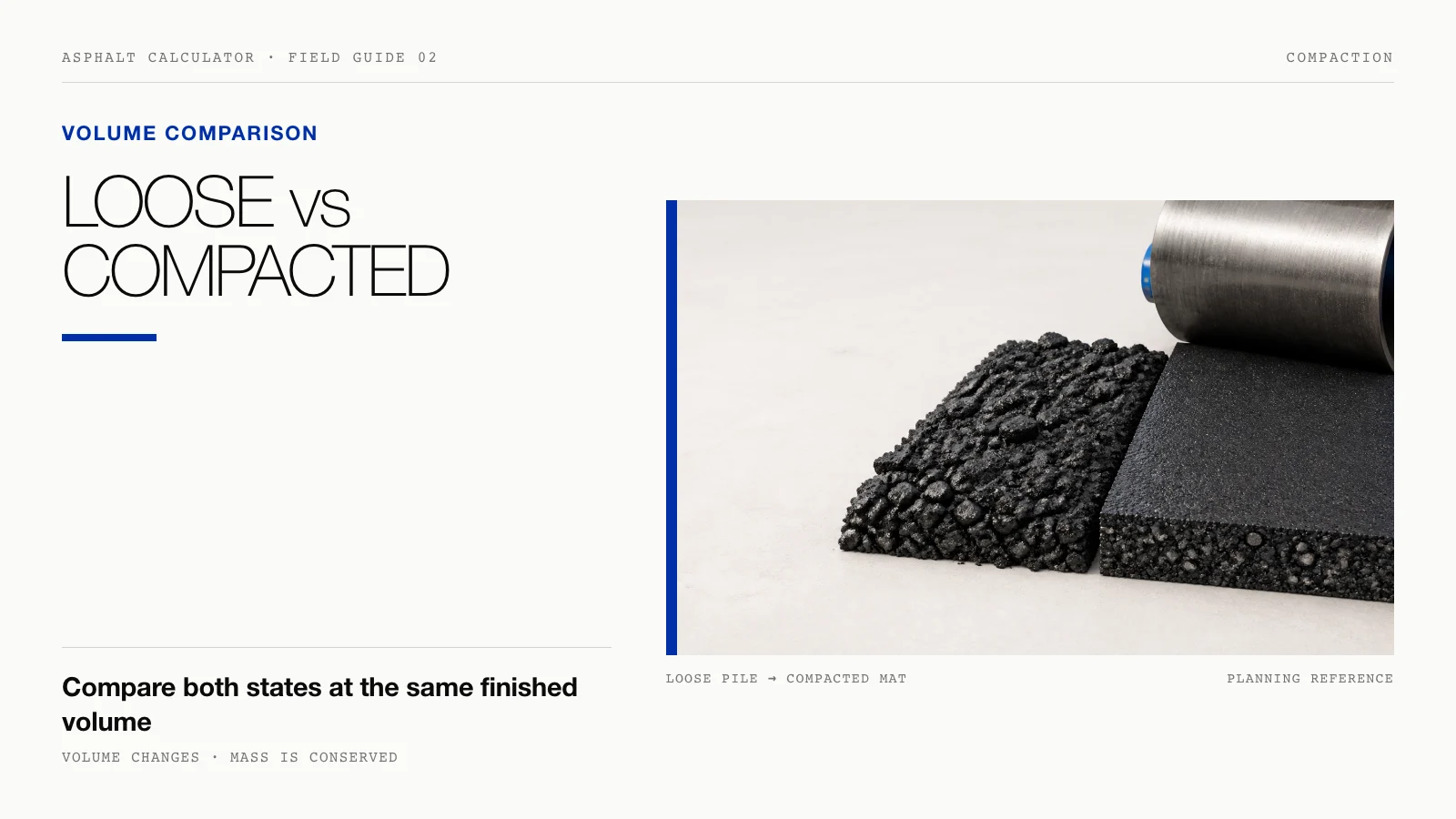
- Loose bulk density may be used for an uncompacted stockpile or truck-volume problem.
- Maximum theoretical specific gravity and percent compaction are laboratory or quality-control concepts; they should not be substituted blindly for field unit weight.
Which density should an estimator use?
Use the most project-specific reliable value available:
- Approved project mix design or agency specification.
- Supplier-provided compacted unit weight for the proposed mixture.
- Project quality-control or acceptance density data, when appropriate.
- A clearly labeled planning assumption only when better data is unavailable.
Record the value, unit, source, and date in the estimate. A bare number such as “145” is ambiguous without lb/ft³, material condition, and source.
Asphalt density calculation example
For 1,000 sq ft at 2 inches compacted thickness:
Volume = 1,000 × 2 ÷ 12 = 166.67 ft³
Weight at 145 lb/ft³ = 166.67 × 145 = 24,166.7 lb
US tons = 24,166.7 ÷ 2,000 = 12.08 tons
At 140 lb/ft³, the same geometry gives 11.67 US tons. At 150 lb/ft³, it gives 12.50 US tons. The geometry did not change; only the density assumption did.
Use the asphalt tonnage chart to compare these values or enter the supplier value in the main asphalt calculator.
Density and tons-to-cubic-yards conversions
A tons-to-volume conversion must include density:
Cubic yards = US tons × 2,000 ÷ density (lb/ft³) ÷ 27At 145 lb/ft³, one US ton occupies about 0.511 cubic yards. At 150 lb/ft³, it occupies about 0.494 cubic yards. This is why a single universal “tons per yard” factor is misleading. Use the asphalt tons-to-cubic-yards calculator for both directions.
Common density mistakes
- Treating a calculator default as a project specification.
- Combining loose volume with compacted density.
- Adding a second “compaction factor” after already using compacted thickness and density.
- Copying a density from a different mixture or aggregate source.
- Omitting units, source, and material condition.
Supplier confirmation checklist
Before finalizing an order, ask:
- What mixture designation will be supplied?
- What compacted density should be used for quantity planning?
- Is the quoted value a target, average, measured result, or conversion assumption?
- Are orders and tickets reported in US tons or metric tonnes?
- How are minimum loads, partial loads, and order rounding handled?
Density improves the arithmetic, but it does not determine pavement thickness or suitability. Those decisions still require traffic, subgrade, drainage, climate, and project specifications.