An asphalt calculator answers a quantity question: how much compacted mixture is required for a measured area and thickness? Pavement engineering answers a different question: what materials and layer structure will carry the expected traffic in the local climate? A reliable project keeps those two tasks separate.
Scope: This guide explains the workflow and the information each decision requires. It is not a mix design, pavement design, bid, or project specification. Agency requirements, laboratory results, supplier data, and sealed plans take precedence.
1. Quantity calculation: area, volume, density
For a rectangular area in imperial units:
Area (ft²) = length × width
Volume (ft³) = area × compacted thickness (in) ÷ 12
Weight (lb) = volume × compacted density (lb/ft³)
Tons = weight ÷ 2,000
Example: a 28 ft × 14 ft area at 2.5 inches compacted thickness has a volume of 81.67 ft³. At an assumed density of 145 lb/ft³, the estimate is 5.92 US tons before any project-specific allowance.
Density is not a universal constant. The mix design or supplier should provide the value used for ordering. Our asphalt calculator uses selectable assumptions for preliminary planning; the figuring asphalt guide explains irregular areas and field checks.
What the calculator does not know
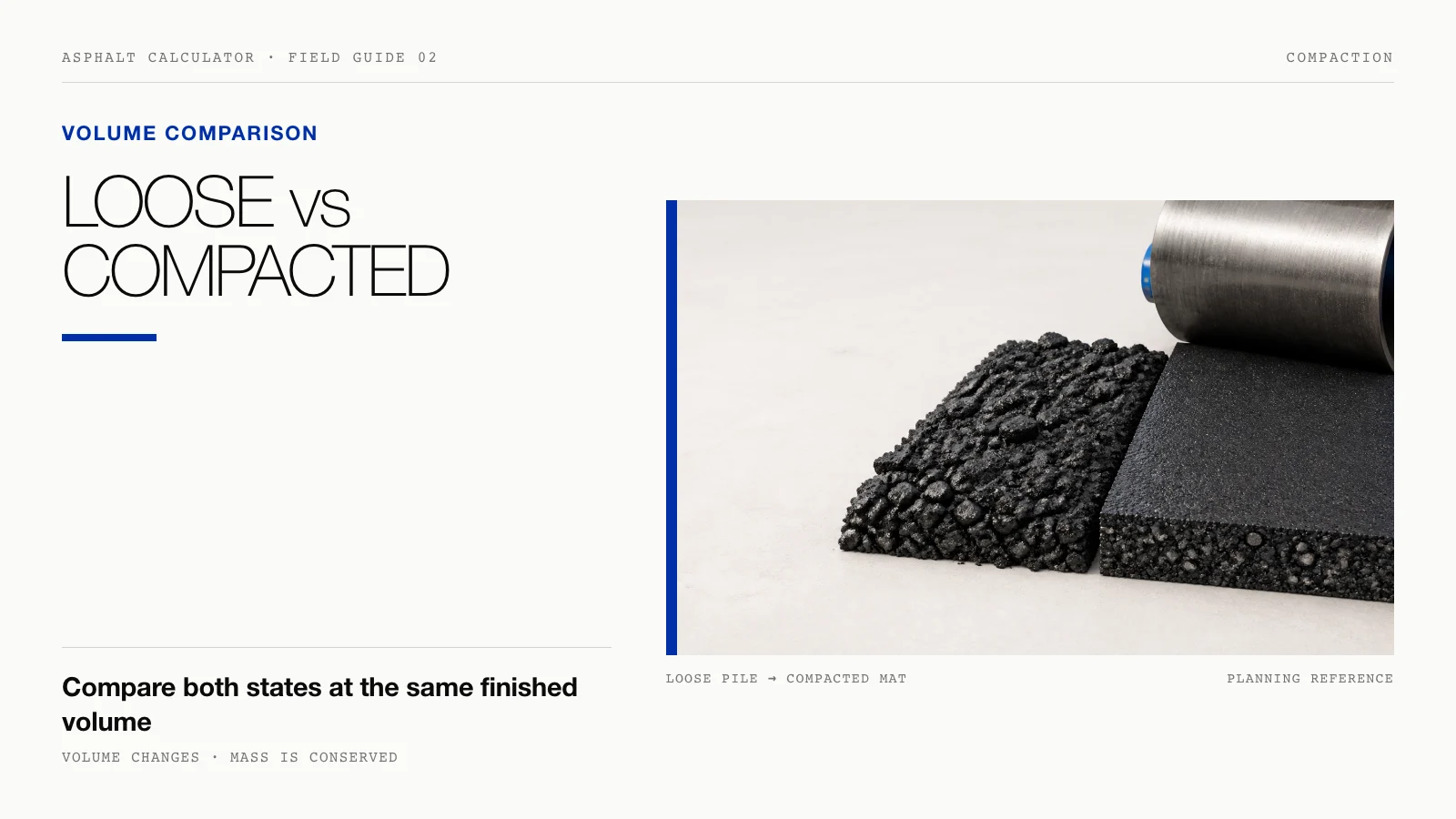
- Whether the entered thickness is compacted or loose
- Low spots and variable-depth leveling courses
- Base repair, drainage, demolition, access, or minimum-load charges
- The approved mixture, target density, or acceptance requirements
- Plant availability, haul time, weather, crew productivity, or bid markup
These omissions explain why a material calculation should not be presented as a final project price.
2. Pavement design starts with traffic, soil, and climate
Layer thickness should not be selected from a generic national table. Engineers evaluate traffic loading, subgrade support, drainage, reliability, climate, construction staging, and the properties of each layer. Residential projects may use local standard details; public roads usually follow an owner or agency design procedure.
Important inputs include:
- Expected vehicle types and loading, not only vehicle count
- Subgrade strength and moisture sensitivity
- Surface and subsurface drainage
- Design life and acceptable risk of early distress
- Existing pavement condition for rehabilitation work
- Local materials and construction constraints
For an existing driveway or parking lot, first decide whether the problem is localized, surface-level, or structural. The repair, overlay, or reconstruction guide provides a screening framework.
3. Mixture and binder selection
Terms such as dense-graded HMA, WMA, stone matrix asphalt, porous asphalt, and cold mix describe broad material families. They are not interchangeable specifications.
Performance-Graded binder names, such as PG 64-22, refer to laboratory performance temperatures under the applicable specification. Selection can also be adjusted for slow or heavy traffic and for recycled binder. Climate-only charts are therefore unsafe as design tools.
The project specification should define, as applicable:
- Aggregate gradation and nominal maximum aggregate size
- Binder grade and modification
- Volumetric requirements such as air voids and VMA
- Moisture susceptibility and performance tests
- RAP or recycled-shingle limits and binder replacement rules
- Production, placement, compaction, and acceptance criteria
See the guide to asphalt types for a non-specialist overview.
4. Warm Mix Asphalt and Reclaimed Asphalt Pavement
The Federal Highway Administration defines Warm Mix Asphalt as a group of technologies that reduce production and placement temperatures relative to conventional HMA. Potential benefits include lower fuel demand, a longer compaction window, longer haul distances, and improved working conditions. The actual temperature reduction and performance depend on the selected technology and mixture.
Reclaimed Asphalt Pavement contributes both aggregate and aged binder. FHWA guidance emphasizes characterization and mix design: increasing RAP is not simply a percentage substitution exercise. The designer must account for variability, aged-binder stiffness, blending assumptions, cracking resistance, rutting resistance, and the owner’s specification.
Neither WMA nor RAP is automatically better or worse. Their value depends on whether the final mixture meets the same project performance and quality requirements.
5. Construction quality controls performance
A sound design can still fail through poor construction. Critical controls include:
- Surface and base preparation — unstable areas and drainage problems are corrected before paving.
- Temperature management — production, haul, placement, and rolling occur within the approved window.
- Lift thickness — the mixture and aggregate size are compatible with the compacted lift.
- Bonding — existing surfaces and lift interfaces are clean and receive a uniform tack coat where specified.
- Compaction — the rolling pattern achieves density without checking, shoving, or aggregate breakdown.
- Sampling and records — test results, delivery tickets, weather, corrective actions, and quantities are documented.
Thin overlays are particularly sensitive to cooling and interface bond. Read Asphalt-on-Asphalt Overlays for that workflow.
6. Costs belong in a dated, local estimate
There is no defensible single “2026 national HMA price.” State asphalt indexes often track liquid binder adjustments rather than the delivered price of a finished mix, and residential installed prices include much more than material.
A useful estimate separates:
| Cost group | Examples |
|---|---|
| Existing conditions | survey, demolition, disposal, unsuitable soil |
| Base and drainage | excavation, aggregate, stabilization, structures |
| Asphalt work | mix, freight, tack, paving, compaction |
| Project delivery | mobilization, traffic control, testing, permits |
| Commercial terms | overhead, risk, contingency, profit, tax |
Record the source date for every price and obtain local quotes. The 2025 asphalt cost guide demonstrates how to read dated indexes without treating them as universal bids.
7. Lifecycle planning
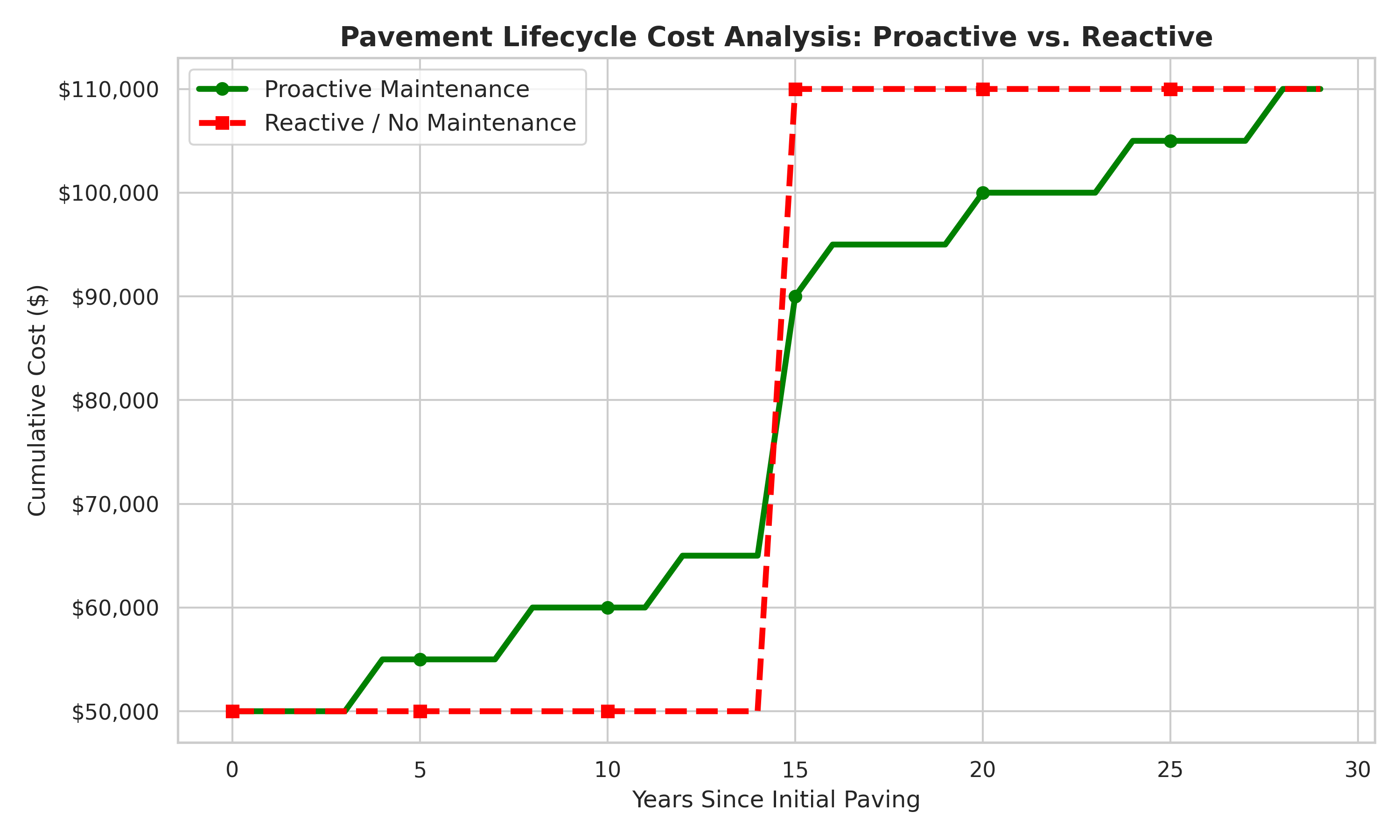
Life-Cycle Cost Analysis compares alternatives over a common analysis period using agency-defined assumptions. It should include future rehabilitation, user impacts where relevant, timing, discounting, and uncertainty—not merely add nominal maintenance costs.
For a small property, the practical version is simpler: inspect regularly, seal appropriate cracks, correct drainage, document repairs, and reserve funds for rehabilitation. Treatment timing should follow condition, not a rigid calendar.
Project handoff checklist
Before relying on a calculation or proposal, confirm:
- Measured area and compacted thickness
- Supplier or mix-design density
- Approved mixture and binder specification
- Base, subgrade, and drainage scope
- Quantity allowance and who owns overrun risk
- Mobilization, minimum load, freight, and disposal
- Testing and acceptance requirements
- Maintenance assumptions and warranty terms
Authoritative references
- FHWA Asphalt Pavement Resources
- FHWA Warm Mix Asphalt
- FHWA: Reclaimed Asphalt Pavement in Asphalt Mixtures
- FHWA Life-Cycle Cost Analysis
- EPA Hot-Mix Asphalt Emissions Resources
The central rule is simple: use calculators for transparent quantity estimates, and use project-specific engineering and specifications for design decisions. Review the density guide and loose-versus-compacted guide before selecting calculation inputs.