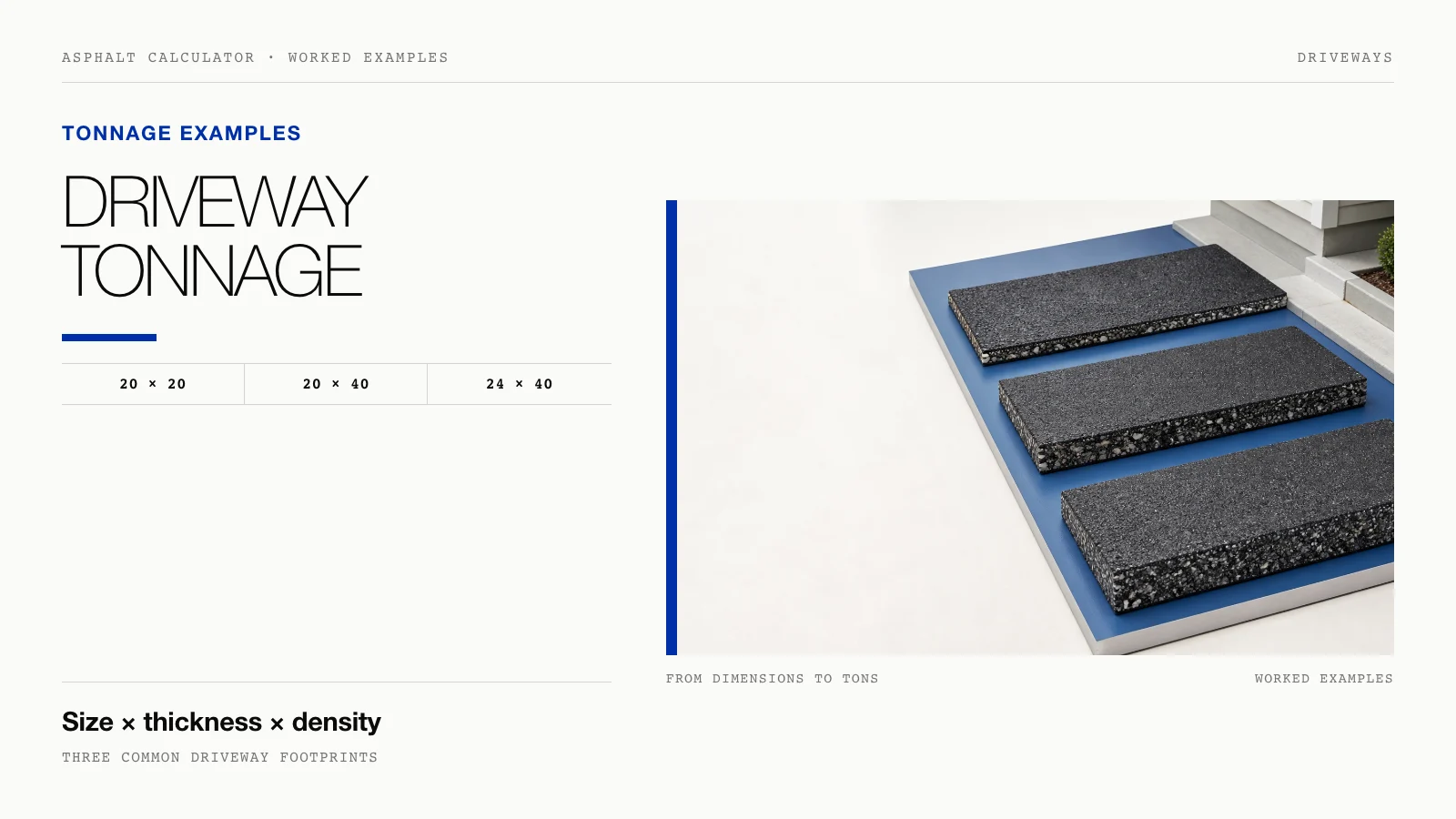
Driveway tonnage depends on four inputs: net paved area, finished compacted thickness, compacted density, and any separately documented ordering allowance. The examples below use an illustrative 145 lb/ft³ density and no allowance so every number can be reproduced.
These are quantity examples, not pavement-thickness recommendations. Traffic, subgrade support, drainage, climate, base condition, and local requirements determine the appropriate section.
Formula used for every example
US tons = length (ft) × width (ft) × thickness (in) ÷ 12
          × density (lb/ft³) ÷ 2,000
At 145 lb/ft³, one inch over 1,000 sq ft equals approximately 6.04 US tons.
20 × 20 ft driveway
Area is 400 sq ft.
| Compacted thickness | Compacted volume | US tons | Metric tonnes |
|---|---|---|---|
| 2 in | 66.67 ft³ | 4.83 | 4.38 |
| 3 in | 100.00 ft³ | 7.25 | 6.58 |
| 4 in | 133.33 ft³ | 9.67 | 8.77 |
For the 3-inch row: 400 × 3 ÷ 12 × 145 ÷ 2,000 = 7.25 US tons.
20 × 40 ft driveway
Area is 800 sq ft.
| Compacted thickness | Compacted volume | US tons | Metric tonnes |
|---|---|---|---|
| 2 in | 133.33 ft³ | 9.67 | 8.77 |
| 3 in | 200.00 ft³ | 14.50 | 13.15 |
| 4 in | 266.67 ft³ | 19.33 | 17.54 |
The 3-inch example is useful for checking calculator arithmetic: 200 ft³ × 145 lb/ft³ = 29,000 lb = 14.5 US tons.
24 × 40 ft driveway
Area is 960 sq ft.
| Compacted thickness | Compacted volume | US tons | Metric tonnes |
|---|---|---|---|
| 2 in | 160.00 ft³ | 11.60 | 10.52 |
| 3 in | 240.00 ft³ | 17.40 | 15.79 |
| 4 in | 320.00 ft³ | 23.20 | 21.05 |
How density changes the result
For the 20 × 40 ft, 3-inch example:
| Compacted density | US tons | Difference from 145 lb/ft³ |
|---|---|---|
| 140 lb/ft³ | 14.00 | −0.50 ton |
| 145 lb/ft³ | 14.50 | baseline |
| 150 lb/ft³ | 15.00 | +0.50 ton |
The FHWA asphalt density report notes that mixtures made with different aggregates can have significantly different densities. Replace the illustrative value with supplier or project data.
Irregular driveways
Do not force an L-shaped, circular, or flared driveway into one oversized rectangle. Divide the surface into measurable sections:
- Calculate each rectangle, triangle, or circle.
- Subtract islands and areas that will not be paved.
- Add the net areas.
- Apply the compacted thickness and density.
The main asphalt calculator supports known area, rectangle, circle, triangle, and multiple-area entry.
Adding an allowance
Calculate base tons first. Then add only an allowance supported by measurement uncertainty, irregular edges, leveling, equipment residue, supplier minimums, or order rounding.
For a 14.50-ton base quantity with a documented 3% allowance:
14.50 × 1.03 = 14.94 US tonsRead the asphalt waste-factor guide before selecting a percentage. Do not use allowance as a second compaction factor.
What these examples exclude
The tables estimate asphalt mixture only. They do not include demolition, excavation, aggregate base, drainage, trucking, labor, equipment, permits, taxes, mobilization, minimum loads, or structural design.
Use the driveway material and cost calculator with your measured dimensions and supplier price. For aggregate quantity, use the asphalt base calculator. Confirm the final scope, thickness, density, quantity, and rounding with the paving contractor and supplier.