Cold patch is a category of asphalt repair materials placed without heating the mixture on site. Bagged products can be useful for small potholes, but their preparation, moisture, lift-depth, and traffic requirements differ. Choose a product for the actual defect and follow its current label and technical data sheet.
Scope: This guide helps homeowners plan small, localized repairs. It is not a universal installation specification. It does not establish structural thickness or replace investigation of a failing base. For a broader material comparison, see hot mix asphalt vs cold patch.
What is in cold patch?
Cold-patch mixtures combine aggregate and an asphalt-based binder system. Depending on the product, workability and hardening may involve cutback binders, emulsions, proprietary additives, or water-activated chemistry. A generic description cannot establish the curing behavior of a particular bag.
Compaction develops aggregate contact and reduces voids. It does not mean every product is fully cured or immediately ready for traffic. Distinguish the manufacturer’s installation requirements, traffic-opening conditions, and later hardening or sealcoating restrictions.
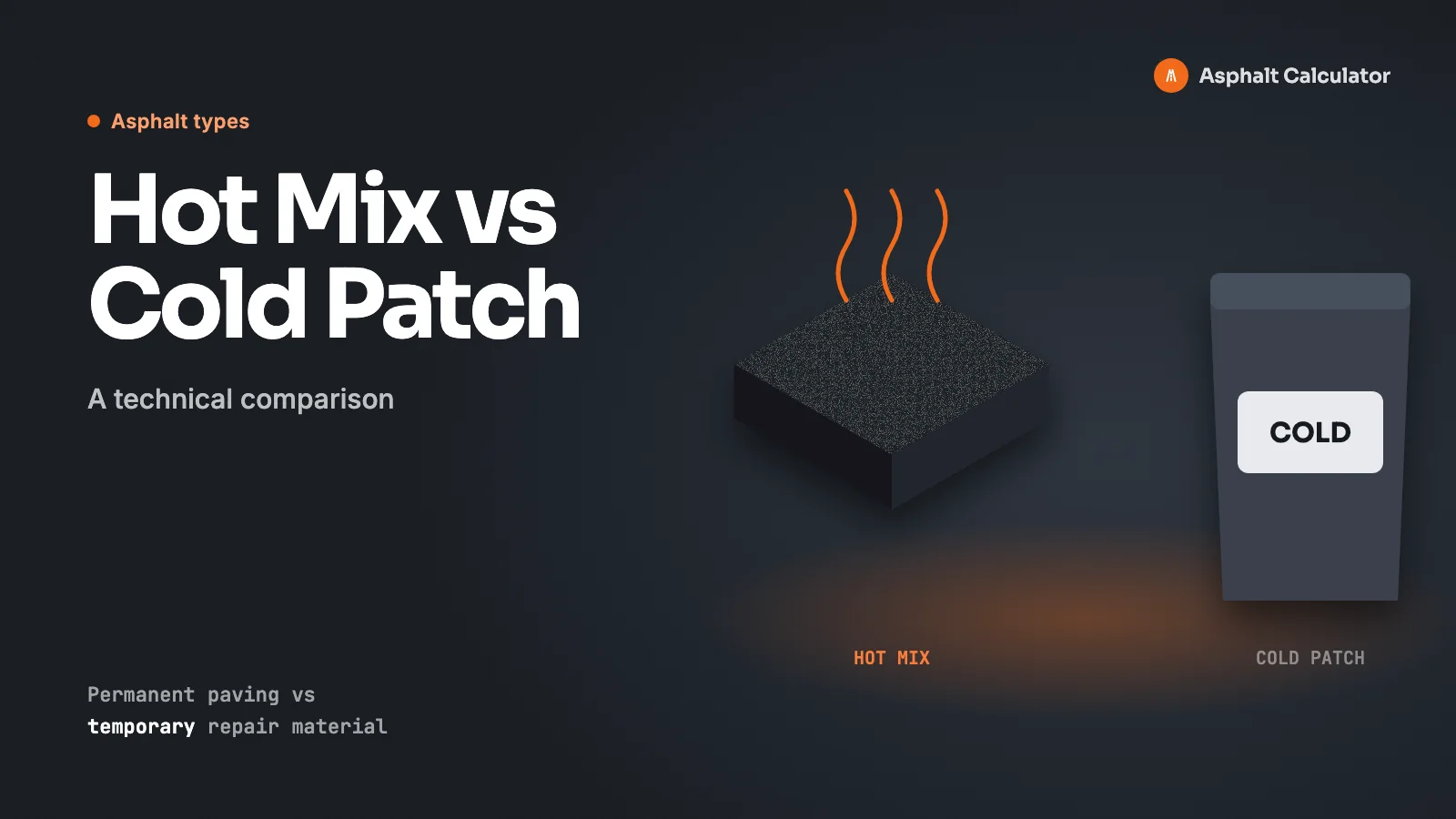
Cold patch and hot mix serve different jobs
| Question | Bagged cold patch | Hot mix asphalt |
|---|---|---|
| Placement | Usually placed without on-site heating; check the product | Delivered and placed within a specified temperature window |
| Typical project | Localized pothole or utility-cut repair when permitted | Paving and repairs with planned transport, placement, and compaction |
| Weather limits | Product-specific temperature and moisture limits | Project-specific surface, weather, temperature, and lift requirements |
| Traffic opening | After the product’s required preparation, compaction, and any waiting period | After required compaction and sufficient cooling under the project procedure |
| Performance | Depends on product, repair geometry, support, preparation, and compaction | Depends on mix, support, bonding, placement, and compaction |
Hot mix is commonly transported in insulated or covered trucks; specialized heated equipment is not a universal requirement. Neither hot nor cold material makes an unstable foundation sound. Avoid choosing on a blanket claim that all cold patches are temporary or all hot-mix patches are permanent.
Decide whether this is a small repair
A localized cavity in otherwise stable pavement is different from a sinking area surrounded by widespread interconnected cracks. Check for recurring potholes, pumping water, soft support, settlement, drainage problems, and deteriorated edges before buying material.
If support is unstable, a surface patch may fail again. Use the repair, resurfacing, or reconstruction guide to organize an inspection. Work on public pavement, near utilities, or around traffic needs the relevant owner’s procedure and suitable work-zone controls.
Cold patch intended for isolated repairs should not be treated as a general driveway resurfacing product. For heavy traffic or a repair expected to remain in service long term, confirm that the exact product and installation method are accepted for that use.
Product checks before starting
Read the current package and technical data sheet together. Record:
- Permitted pavement surfaces and defect sizes
- Minimum and maximum application temperatures
- Whether the cavity must be dry, may be damp, or may contain water
- Whether added water, primer, or another preparation step is required
- Minimum and maximum compacted lift depths
- Required compaction equipment and finishing level
- Conditions for opening to traffic and applying a later sealcoat
A product advertised as all-weather still has installation conditions. For example, Sakrete U.S. Cold Patch has its own application instructions; do not transfer them to a different brand or chemistry.
Plan the quantity
Measure the prepared cavity, including sound edges and the depth that will actually receive patch material. For several defects, record each separately and add their volumes. Use the pothole repair calculator with the selected product’s coverage or density and bag size.
The estimate does not tell you whether deeper support needs replacement. Keep any base repair quantity separate. Buying extra bags does not correct a drainage or support problem.
Installation checkpoints
1. Prepare the work area and equipment
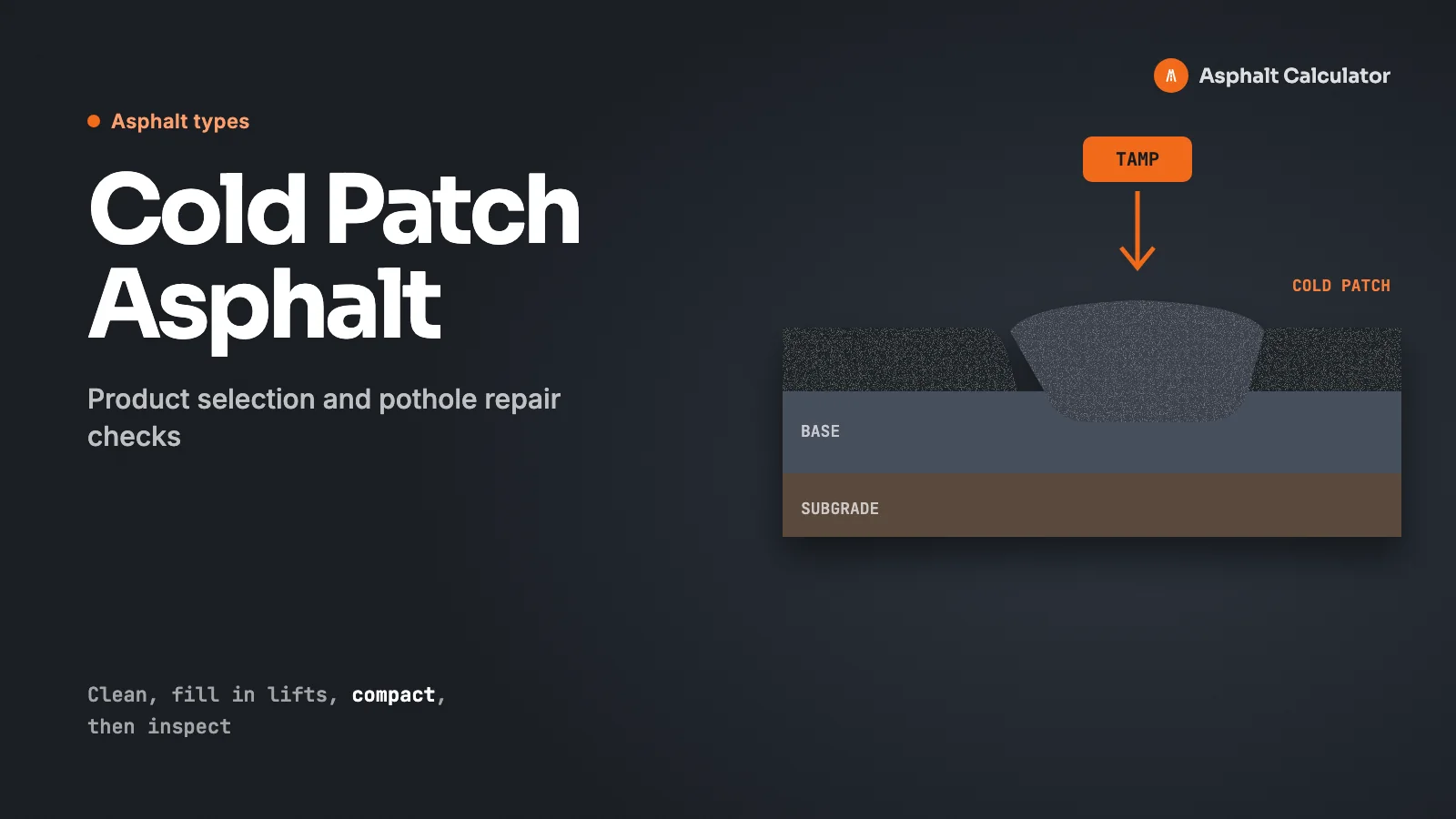
Keep people and vehicles out of the repair area. Use the protective equipment and tools specified for the product. A hand tamper may suit some small repairs; larger or deeper repairs may require different equipment.
2. Prepare the cavity and check moisture
Remove loose, unsound material as required by the selected method. Check the exposed support. Follow the product’s moisture instructions: some products require removal of standing water or a dry surface, while others permit wet placement or require water activation.
Do not enlarge or saw-cut a cavity solely because a generic online guide says to do so. Edge preparation depends on the repair method, pavement condition, and nearby utilities. Stop and reassess if the base is soft or pumping.
3. Place and compact to the specified lift depth
Use the manufacturer’s permitted lift thickness and compact each lift as directed before adding another. A thick fill compacted only at the surface can leave weak material below. There is no single two-inch lift rule that applies to every product and repair.
Do not add gravel simply to reduce the amount of patch material. Any base replacement needs a suitable material, thickness, and compaction procedure for the repair.
4. Finish to the specified level
Follow the label’s overfill and final-level instructions. Required overfill varies; a universal half-inch or one-inch crown is not appropriate for every material. Check transitions and drainage after compaction, and avoid leaving a trip hazard or an obstruction to water flow.
5. Check before opening to traffic
Open the area only when the selected product’s compaction and traffic-opening requirements are met for the actual conditions. Some products permit immediate traffic after proper installation; others specify additional conditions. Do not use passing vehicles as a substitute for required initial compaction.
Common follow-up questions
Why is the repair still soft?
Some products continue to harden after placement. Persistent tracking, displacement, settlement, or material pickup requires comparison with the product instructions and possibly advice from the manufacturer. More traffic is not a universal remedy.
Can I sealcoat over it?
Confirm compatibility and timing with both the patch and sealcoat manufacturers. Do not assume a universal 30-day waiting period.
How long will it last?
There is no defensible lifespan for all cold patches. Product selection, preparation, support, compaction, water, and loading matter. Keep a dated repair record and inspect for renewed movement or water entry.
Sources and scope
- FHWA: Materials and Procedures for Repair of Potholes in Asphalt-Surfaced Pavements — repair materials, methods, and evaluation; not a current installation label for every retail product.
- Sakrete U.S. Cold Patch — one manufacturer’s product information, not a specification for other cold patches.