An asphalt calculator converts measured geometry into an estimated volume and weight of paving mixture. It is useful for early budgeting, comparing contractor quantities, and preparing a material inquiry. It does not determine whether the base is sound, what mixture is approved, or how thick a pavement should be.
The National Asphalt Pavement Association reports that asphalt surfaces about 94% of paved roads in the United States. That statistic describes U.S. pavement use—not global road coverage—and it does not make one calculation method suitable for every road or driveway.
The calculation in four steps
For a rectangular project using imperial units:
Area (ft²) = length (ft) × width (ft)
Volume (ft³) = area × compacted thickness (in) ÷ 12
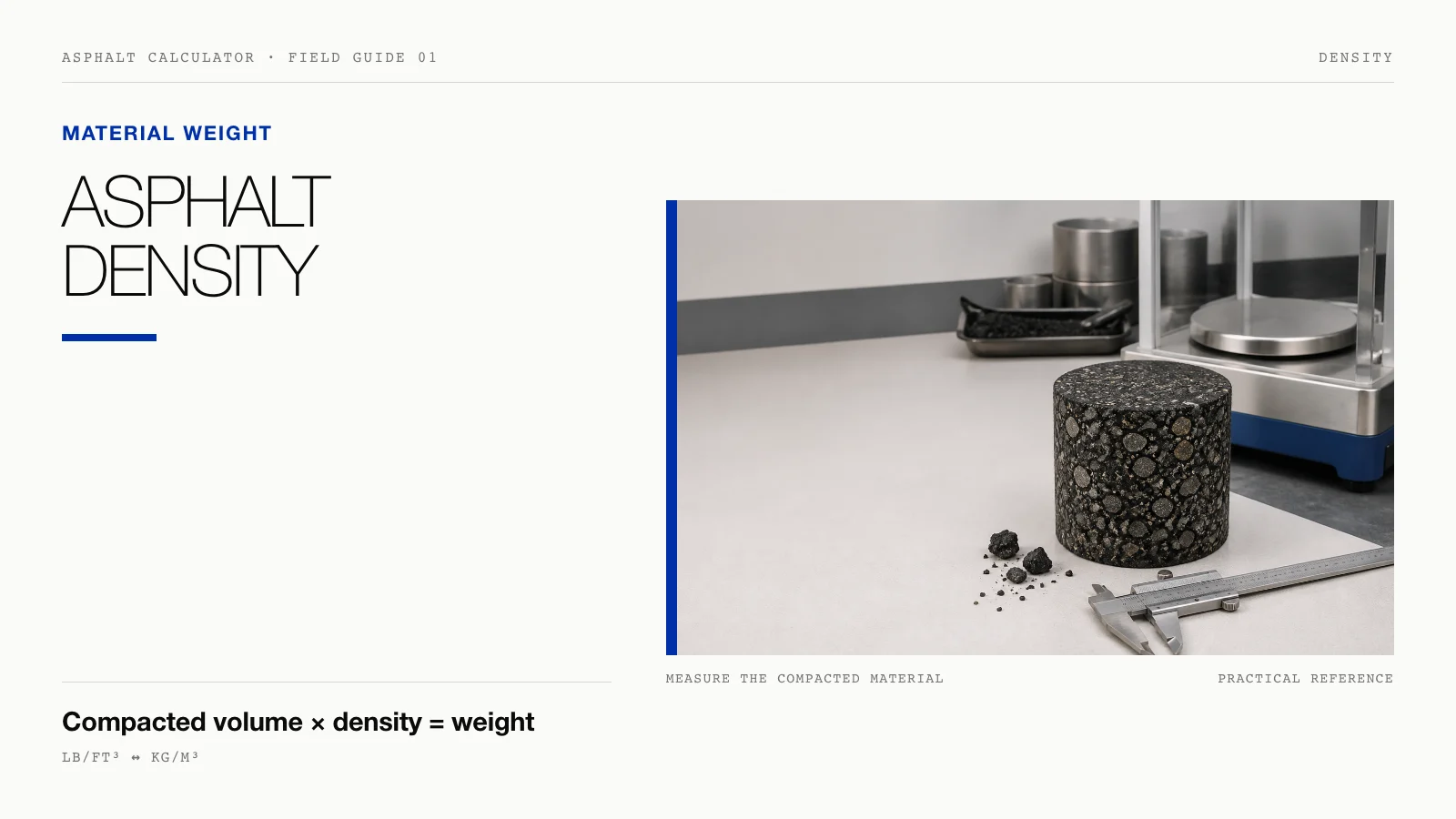
Weight (lb) = volume × compacted density (lb/ft³)
US tons = weight ÷ 2,000
For metric inputs:
Area (m²) = length × width
Volume (m³) = area × compacted thickness (cm) ÷ 100
Metric tonnes = volume × density (kg/m³) ÷ 1,000
The arithmetic is simple. The quality of the result depends on the inputs.
Worked example: a residential driveway
Assume a rectangular driveway measures 20 ft × 40 ft and the planned compacted asphalt thickness is 3 inches.
- Area:
20 × 40 = 800 ft² - Volume:
800 × 3 ÷ 12 = 200 ft³ - At an assumed density of 145 lb/ft³:
200 × 145 = 29,000 lb - Weight:
29,000 ÷ 2,000 = 14.5 US tons
This is a transparent planning estimate—not an order quantity. Before ordering, confirm the compacted thickness, supplier density, low areas, project geometry, minimum-load policy, and any allowance with the contractor or plant.
The three inputs most often misunderstood
Compacted thickness
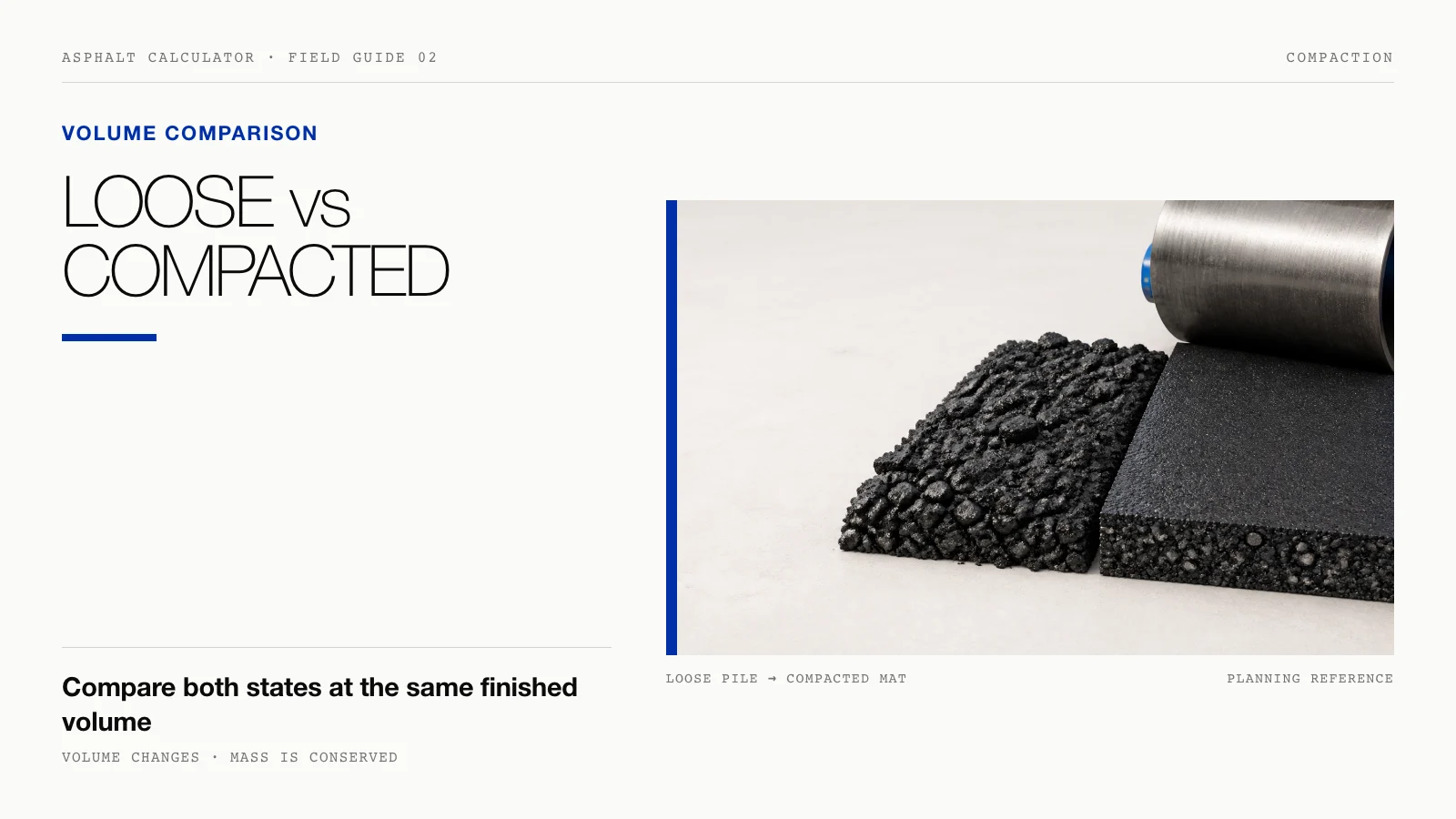
Enter the finished compacted thickness, not the loose depth placed ahead of the roller. Thickness should come from the project detail or a qualified local professional. A calculator cannot design a pavement from vehicle type alone.
Density
Published shortcuts often assume roughly 140–150 lb/ft³ for compacted asphalt mixture, but actual mix density varies. When available, use the value from the approved mix design or supplier. A small density change scales the estimated tonnage by the same percentage.
Quantity allowance
An allowance can cover measurement uncertainty, irregular edges, leveling, and material remaining in equipment. It should not be used to count compaction twice: density and compacted thickness already describe the compacted material. Agree on a project-specific allowance instead of automatically adding a universal percentage.
Irregular and circular areas
Divide an irregular layout into measurable shapes:
- Rectangles:
length × width - Triangles:
base × height ÷ 2 - Circles:
π × radius²
Add the areas, then apply thickness and density once. For curved driveways, several short measured sections are usually more reliable than one “average width” guess. Large sites may justify a survey, plan takeoff, or geospatial measurement.
What an asphalt calculator can and cannot do
| It can help with | It cannot determine |
|---|---|
| Area, volume, weight, unit conversion | Required structural thickness |
| Comparing density assumptions | Subgrade strength or base failure |
| Material-only cost scenarios | Drainage corrections or demolition scope |
| Checking the quantity in a proposal | Mix approval, haul window, or compaction plan |
| Saving repeatable inputs | A contractor’s labor, equipment, overhead, and risk |
That boundary matters. A precise-looking number can still be wrong if the site condition or design assumption is wrong.
Using the estimate in a real project
Homeowners
Use the number to ask better questions:
- Is the quote based on compacted thickness?
- Which mix and density were assumed?
- Are base repair, drainage, removal, and disposal separate?
- Is the tonnage a fixed quantity or measured from delivery tickets?
For ownership costs, see the asphalt driveway cost guide.
Contractors
A bid quantity should be reconciled with plans, field measurements, yield history, paving sequence, leveling requirements, plant minimums, truck cycles, and the party responsible for overruns. Delivery tickets and actual yield provide feedback for future estimates.
Engineers and public owners
Quantity is downstream of design. Traffic, subgrade, climate, drainage, layer coefficients or mechanistic analysis, approved mixtures, and acceptance requirements determine what gets calculated. See the 2026 pavement engineering guide for the broader workflow.
Common calculation errors
- Entering inches as feet or centimeters as meters
- Using total pavement depth as asphalt thickness
- Confusing loose and compacted thickness
- Applying a density for the wrong mixture
- Forgetting triangular, curved, or widened areas
- Treating material cost as installed project cost
- Adding both a “compaction factor” and compacted density without understanding what each represents
A practical pre-order checklist
- Re-measure length and width
- Label every unit
- Confirm compacted thickness
- Obtain the supplier or mix-design density
- Split irregular geometry into auditable shapes
- Document the allowance and why it is used
- Confirm plant minimums and delivery constraints
- Compare the estimate with the contractor’s takeoff
Use the online asphalt calculator to test the arithmetic, compare assumptions in the asphalt density guide, or use the tons-to-cubic-yards calculator for a density-based weight and volume conversion. The Complete Guide to Figuring Asphalt covers role-specific estimating considerations.
Sources
- National Asphalt Pavement Association: Asphalt Pavement Facts
- Federal Highway Administration: Asphalt Pavement Resources
- Federal Highway Administration: Life-Cycle Cost Analysis
An asphalt calculator is most valuable when every assumption is visible. It should make an estimate easier to audit—not make uncertain inputs look authoritative.