Asphalt millings are pieces of existing asphalt pavement removed by a milling machine, often sold as recycled asphalt, crushed asphalt, or reclaimed asphalt pavement (RAP). Some property owners place them as an unbound driveway surface in place of gravel. That can work in the right setting, but millings are not the same product as new hot mix asphalt, and their performance depends heavily on the source material, base, drainage, and compaction.
This guide covers where millings fit, how to estimate quantity from compacted depth, how placement affects results, and which limits to confirm before ordering. To size an order, use the asphalt millings calculator.
What asphalt millings are
When a road or parking lot is milled, the removed material is a mix of aged asphalt binder and aggregate. Suppliers may crush and screen it to a gradation, or sell it as delivered. The same material can go two different ways:
- As an ingredient in new plant-produced asphalt mixture. Here RAP is a controlled component of a hot mix design.
- As an unbound granular material placed and compacted on site, similar to crushed aggregate. A millings driveway is this second use.
These are different products. Advice that applies to plant mixtures containing RAP does not automatically apply to loose millings spread on a driveway.
What the research says about millings as a base material
The Federal Highway Administration’s user guidelines for reclaimed asphalt pavement in granular base describe several properties that matter for a driveway:
- Bearing capacity is lower than conventional aggregate. FHWA notes that RAP by itself may have lower bearing capacity than conventional granular base, and that bearing capacity decreases as RAP content increases.
- Blending is usually needed for load-bearing layers. FHWA states that blending granular RAP with suitable materials is necessary to reach the bearing strengths needed for most load-bearing unbound applications.
- The asphalt coating resists compaction. Compacted density of a blend tends to decrease as RAP content increases, because the binder coating inhibits compaction.
- Drainage behavior is similar to conventional base. FHWA reports that the permeability of blended material containing RAP is similar to conventional granular base.
These findings come from highway base applications, which carry far heavier loads than most driveways. They still explain the common driveway experience: millings perform best on a firm, well-drained base and when they are compacted thoroughly, and a soft subgrade will show through.
When a millings driveway can make sense
Millings are usually considered for:
- Long rural or private driveways where a fully paved surface is not required.
- Replacing or topping an existing gravel driveway that already has a working base and drainage.
- Light passenger-vehicle traffic at low speed.
- Owners who accept periodic regrading and topping up, as with gravel.
They are a weaker fit for:
- Steep slopes, where loose material can migrate and water runs down the surface.
- Sites with standing water, poor drainage, or soft clay subgrade that has not been corrected.
- Driveways that must meet a municipal paving requirement, an HOA rule, or a commercial access standard.
- Locations near wells, streams, wetlands, or drainage channels where reuse of waste asphalt is restricted (see rules and permits).
If the base is failing, millings will not fix it. Correct drainage and subgrade first, then choose the surface.
Millings vs gravel vs hot mix asphalt
| Factor | Asphalt millings | Crushed gravel | Hot mix asphalt |
|---|---|---|---|
| Surface | Unbound, can tighten with traffic and compaction | Unbound, stays loose | Bound, continuous pavement |
| Dust and loose stone | Typically less than gravel once compacted | More | Minimal |
| Structural support | Lower than conventional aggregate unless blended | Depends on gradation | Designed layer |
| Ongoing work | Regrading, topping up, patching | Regrading, topping up | Crack sealing, sealcoat, patching |
| Product consistency | Varies by source pavement and processing | Specified gradations available | Specified mix design |
The table is qualitative. Price and availability vary by region and season, so compare current local quotes rather than relying on national averages.
How much millings do you need?
Estimate from net area × compacted thickness × placed bulk density. Use the compacted depth you intend to finish with, not the loose depth dumped from the truck. The bulk density must come from the supplier or a measurement of the actual material, because millings vary with source, gradation, moisture, and compaction.
Volume (ft³) = area (ft²) × compacted thickness (in) ÷ 12
Weight (US tons) = volume (ft³) × placed bulk density (lb/ft³) ÷ 2,000
Cubic yards = volume (ft³) ÷ 27
Worked example: 12 × 50 ft driveway
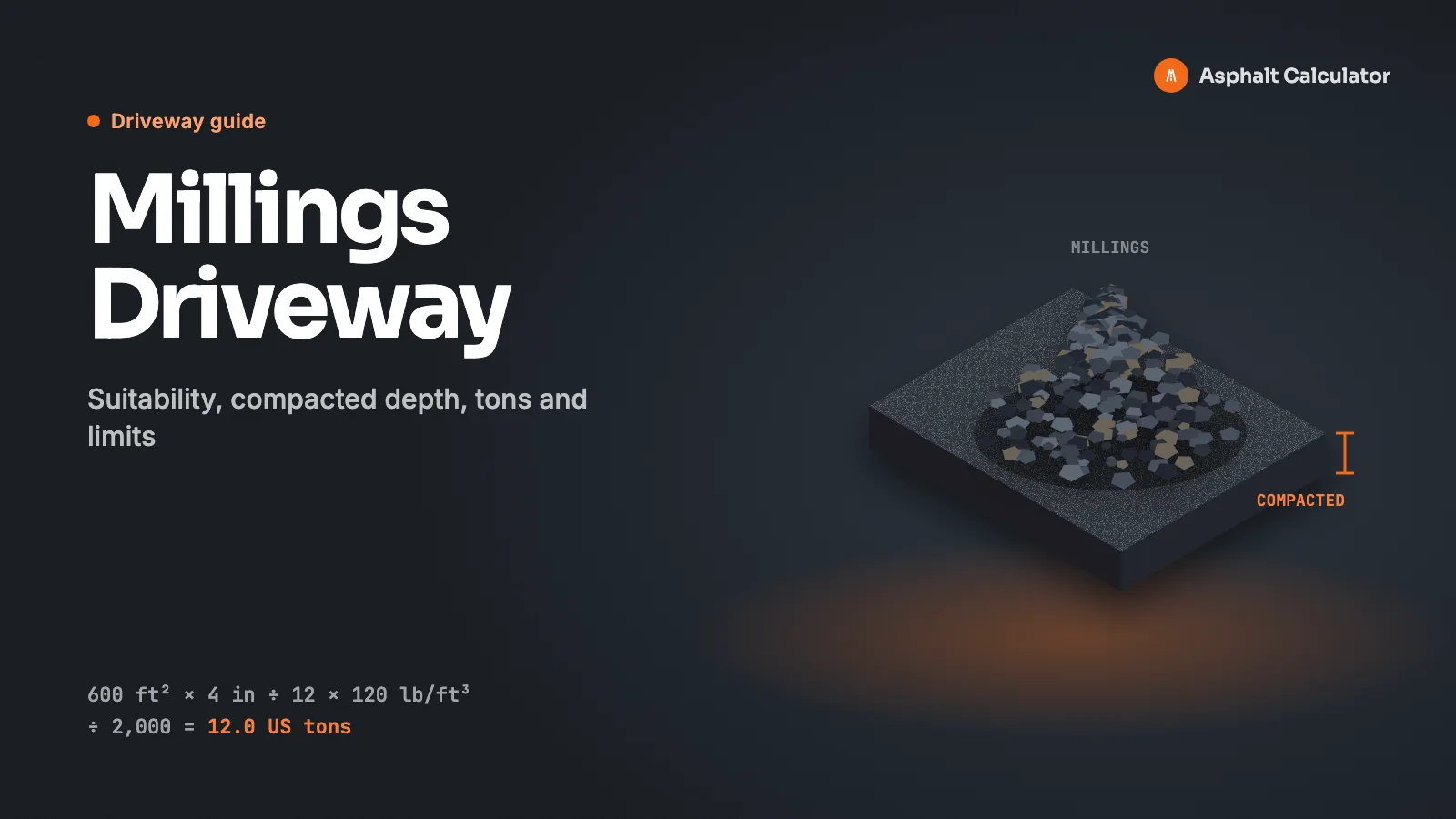
Assume a 12-foot-wide, 50-foot-long driveway (600 sq ft) and an illustrative placed bulk density of 120 lb/ft³, the same assumption used on the millings calculator page. Replace it with your supplier’s value.
| Compacted thickness | Volume | Weight at 120 lb/ft³ |
|---|---|---|
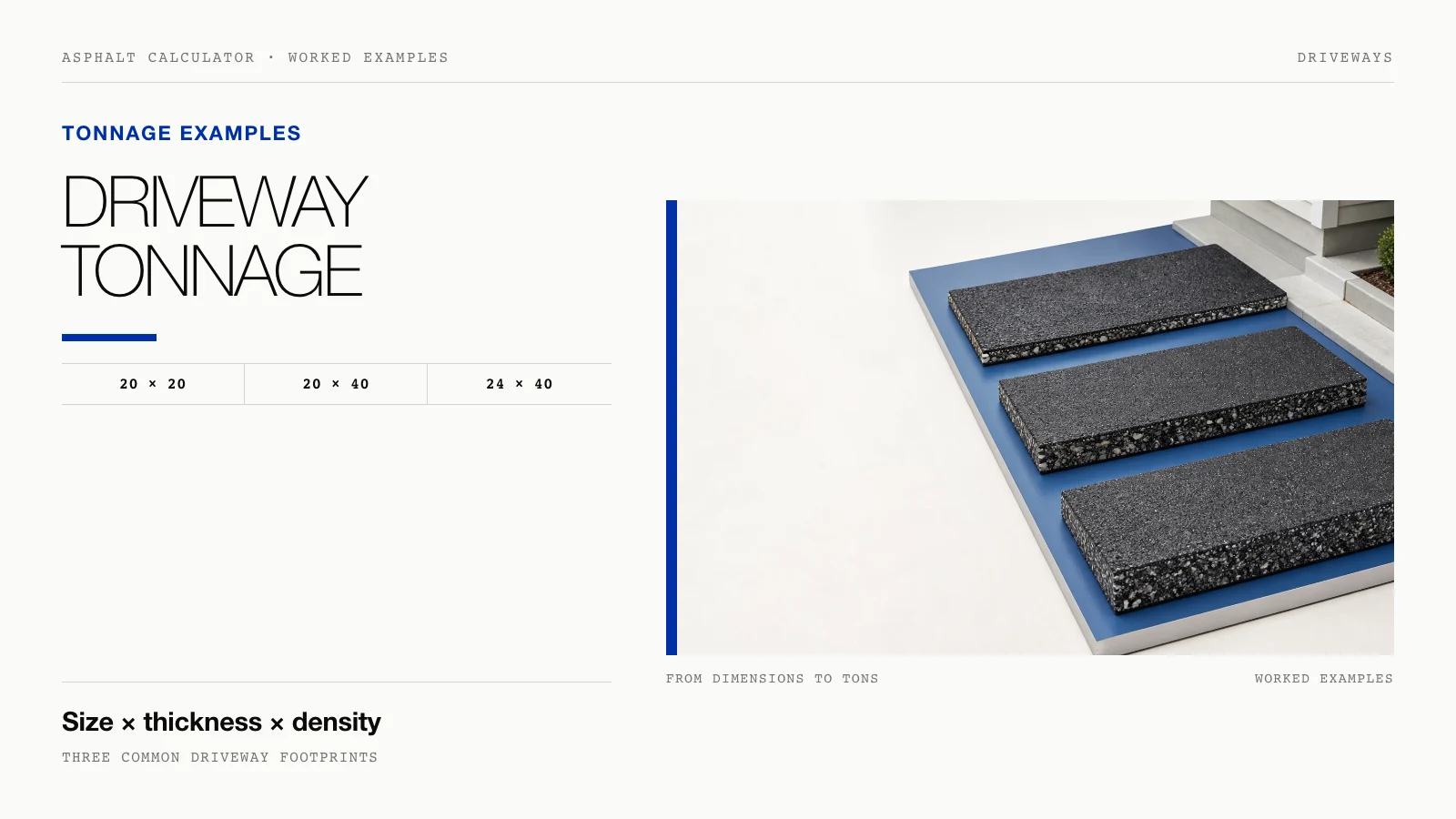
| 3 in | 150 ft³ · 5.56 yd³ | 18,000 lb · 9.0 US tons |
| 4 in | 200 ft³ · 7.41 yd³ | 24,000 lb · 12.0 US tons |
| 6 in | 300 ft³ · 11.11 yd³ | 36,000 lb · 18.0 US tons |
For the 4-inch row: 600 × 4 ÷ 12 = 200 ft³, then 200 × 120 ÷ 2,000 = 12.0 US tons.
These are quantity examples, not depth recommendations. The right thickness depends on the base underneath, the vehicles using the driveway, drainage, and climate. If you add an ordering allowance for irregular edges or supplier rounding, record the reason separately, as described in the waste factor guide. The truckload calculator converts the result into dispatches.
Placement and compaction checklist
How millings are placed matters as much as the quantity.
- Prepare the subgrade and drainage. Remove soft or organic soil where needed, and shape the surface so water drains off and away from the driveway.
- Use a working base where the subgrade is weak. The aggregate base calculator estimates base quantities separately.
- Spread in lifts. Thick single lifts are harder to compact evenly. Ask the contractor what lift thickness their equipment can compact.
- Control moisture. Compaction depends on moisture. Follow the contractor’s or supplier’s practice instead of guessing.
- Compact with suitable equipment. A roller compacts far more effectively than vehicle traffic alone. Because the asphalt coating resists compaction, under-compacted millings tend to rut and ravel.
- Crown or cross-slope the surface so water sheds instead of ponding.
- Restrain the edges where traffic or runoff would otherwise push material outward.
Some installers apply an emulsion or other binder to help millings stay in place. Product choice and application rate are site-specific, so confirm them with the supplier and any local rules.
Rules, permits, and environmental limits
Reused asphalt is regulated differently from place to place. Some state environmental agencies publish placement conditions for waste or reclaimed asphalt. Montana DEQ’s waste asphalt guidance, for example, addresses where it may be placed relative to groundwater and surface water. Local governments may also have dust-control or paving requirements. Clark County, Nevada publishes guidance on alternative asphalt surfaces under its dust-control program.
Before ordering, check:
- Your state environmental agency’s rules on reclaimed asphalt reuse.
- County or city requirements for driveway surfaces, especially at the public road apron.
- HOA covenants or deed restrictions.
- Setbacks from wells, streams, wetlands, and drainage channels.
Maintaining a millings driveway
Expect gravel-style upkeep:
- Regrade ruts and washboarding before they deepen.
- Top up thin areas with matching material and recompact.
- Fix drainage at the first sign of ponding or washouts.
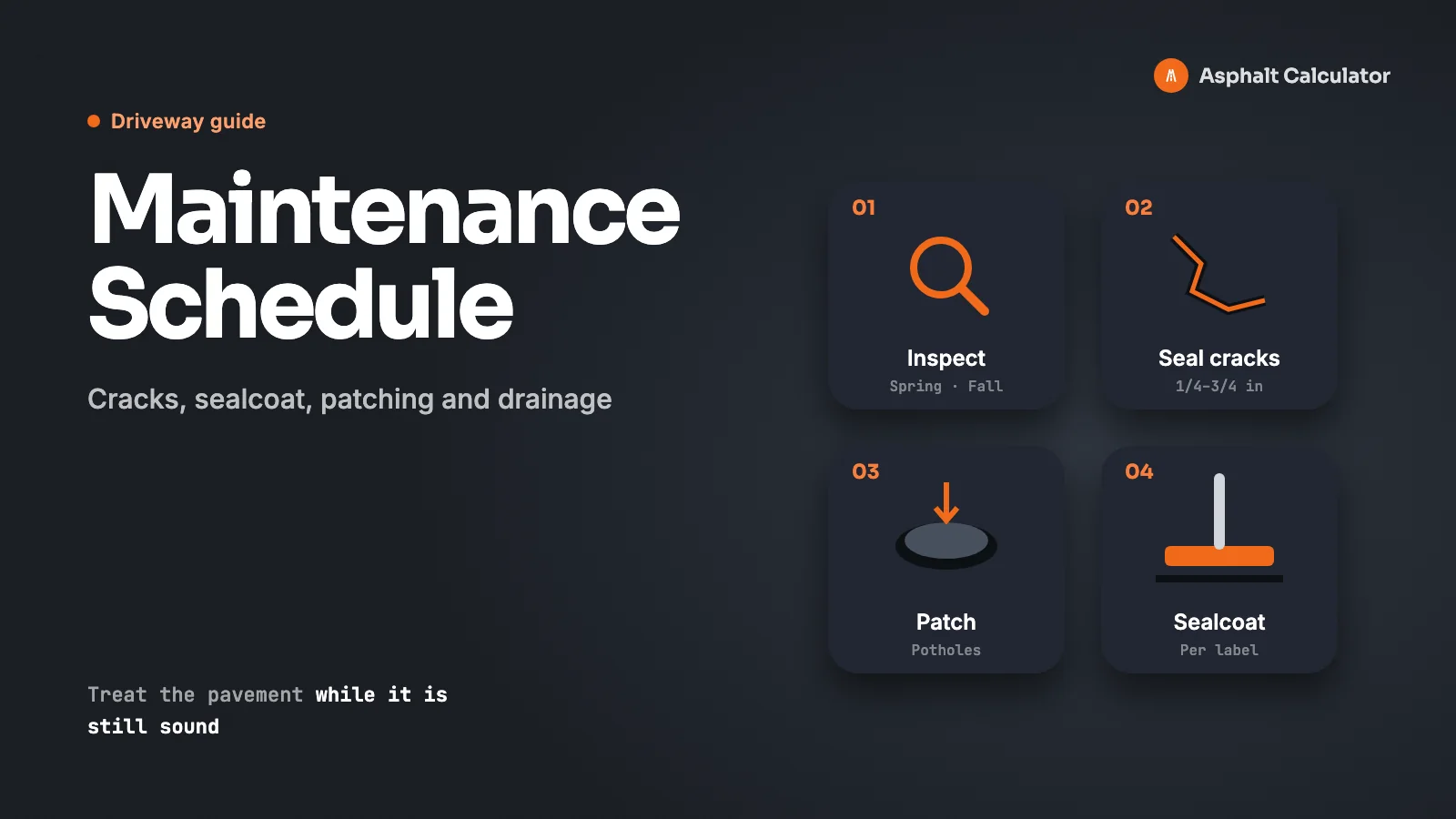
- Patch potholes by cleaning out loose material, refilling in thin compacted layers, and checking drainage at the spot.
A millings surface does not need sealcoat in the way hot mix asphalt does. Treat any binder product used on it according to the manufacturer’s instructions.
Questions to ask the supplier
- What is the source pavement, and has the material been crushed and screened?
- What gradation or maximum particle size should I expect?
- Is it free of soil, concrete, and debris?
- What placed bulk density should I use for estimating, and how was it determined?
- Is it sold by weight or by volume, and what is the minimum load?
- Are there any restrictions on where it may be placed?
Related tools and guides
- Asphalt millings calculator: cubic yards and tons from area, compacted depth, and bulk density.
- Asphalt density guide: why density values must come from the actual material.
- Loose vs compacted asphalt: avoid double-counting compaction.
- Asphalt driveway maintenance schedule: upkeep for paved driveways.
Sources
- Federal Highway Administration, Reclaimed Asphalt Pavement: Material Description and User Guideline: Granular Base, FHWA-RD-97-148.
- Federal Highway Administration, Reclaimed asphalt pavement resources.
- Montana Department of Environmental Quality, Guidance for waste asphalt.
- Clark County, Nevada, Guidance on alternative asphalt use.